
TokenPost.ai
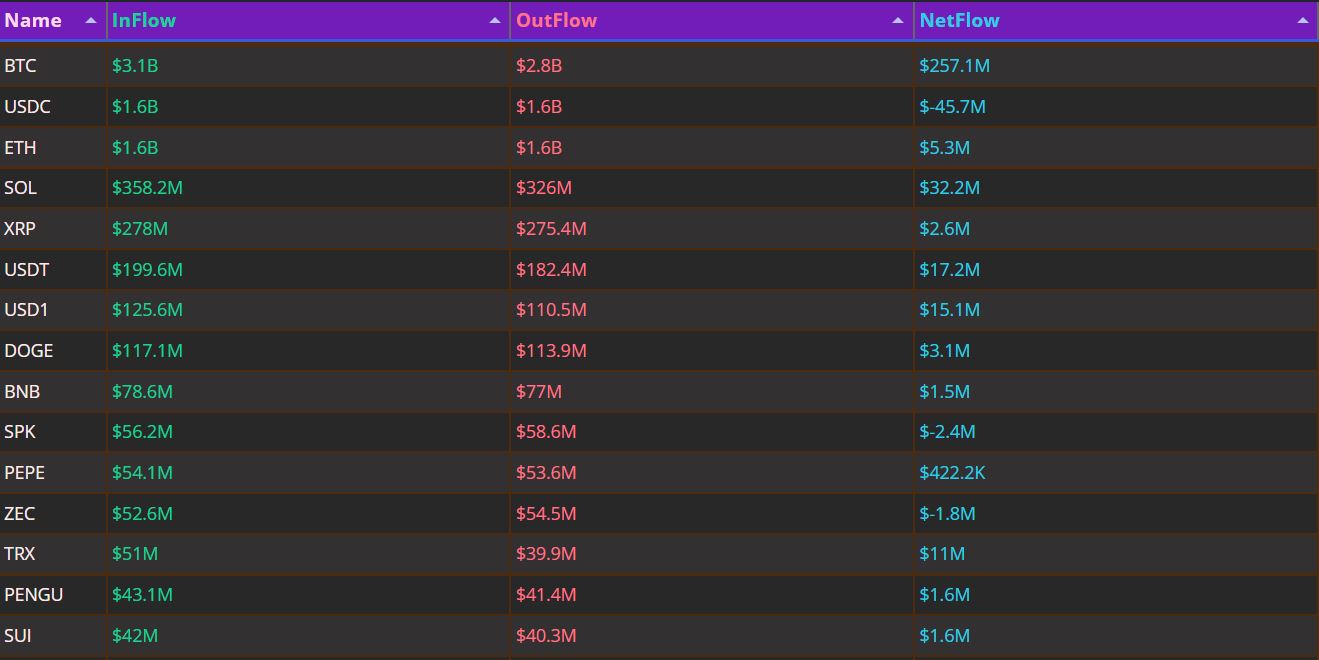
Bitcoin (BTC) saw a sharp wave of ‘net inflows’ over the past 24 hours, while USD Coin (USDC) posted the largest ‘net outflow’ among major crypto assets—an inversion that can signal rotation in where traders are parking liquidity and taking risk.
According to Cryptometer data cited at 1:35 a.m. ET on April 23 (based on flows recorded over the prior 24 hours), Bitcoin registered approximately $257.1 million in net inflows. Tether (USDT) also attracted capital, posting $17.2 million in net inflows, while Solana (SOL) added $32.2 million. Ethereum (ETH) recorded a modest $5.3 million net inflow.
USDC, however, moved in the opposite direction, logging about $45.5 million in net outflows—the biggest capital exit in the dataset. Smaller outflows were also recorded in a handful of assets, including RAVE with $5.7 million and WBETH with $2.4 million in net outflows.
By ranking, Bitcoin led inflows by a wide margin, followed by SOL, USDT, USD1 with $15.1 million, and TRON (TRX) with $11.0 million. On the outflow side, USDC topped the list, followed by RAVE and WBETH.
While flow data does not identify the underlying source of capital movements, the split between strong BTC inflows and USDC outflows may point to short-term repositioning—either from stablecoin balances into higher-beta exposure, or a shift in venue and settlement preferences among traders. In the near term, sustained inflows into BTC and major liquid assets are often watched as a proxy for broader ‘risk-on’ engagement, while stablecoin outflows can reflect redemptions, transfers between platforms, or temporary changes in liquidity demand.
Article Summary by TokenPost.ai
🔎 Market Interpretation
- Notable rotation signal: The dataset shows a sharp divergence—Bitcoin (BTC) posted the strongest net inflow (~$257.1M) while USD Coin (USDC) saw the largest net outflow (~$45.5M), suggesting liquidity may be shifting from stablecoin parking to higher-risk exposure.
- Risk-on bias (near term): When top liquid assets (especially BTC) attract sustained inflows, it is commonly interpreted as increased speculative participation or renewed directional conviction.
- Stablecoin outflows are ambiguous: USDC outflows can reflect redemptions, transfers between exchanges/venues, or reduced demand for idle liquidity—not necessarily bearish on their own.