
TokenPost.ai
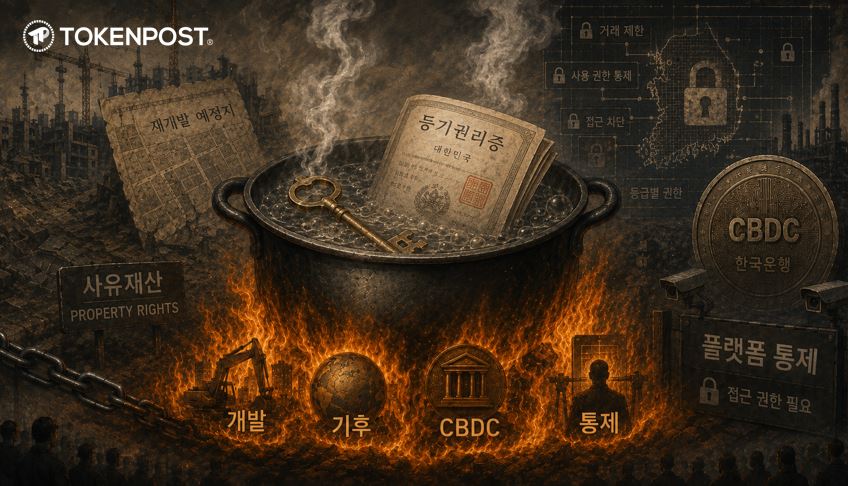
As governments and platforms accelerate digital policy—from land development and climate mandates to digital administration and next-generation payment rails—an old liberal-democratic premise is being tested: whether citizens can still treat what they own as truly theirs, rather than a permissioned privilege contingent on compliance.
The debate is no longer confined to property disputes over housing and land. It is increasingly shifting toward money itself, as central bank digital currency (CBDC) experiments, tokenized bank deposits, and fiat-backed stablecoins reshape how value is issued, stored, and spent. At stake is not only efficiency, but the boundaries of control: who sets the rules of use, who can see transaction data, and under what conditions a person’s assets can be restricted.
In South Korea, compulsory land acquisition for public projects has long been normalized. Industrial complexes, new towns, roads, railways, transmission grids, and energy facilities routinely place privately owned homes and farmland beneath state planning decisions. The push for strategic semiconductor clusters and renewable energy infrastructure has added momentum. Supporters argue such projects are indispensable to competitiveness and the public interest, but critics note that “compensation” on paper often fails to replace the real-life value of a lifetime-built farm, a community, or a single home meant for retirement.
At the same time, the market-based path to ownership has narrowed. Where homeownership once served as a middle-class ladder, it has become increasingly difficult for ordinary wage earners to buy property in the greater Seoul area. That shift, in turn, is changing social expectations—especially among younger Koreans—undermining the belief that work and saving reliably translate into assets. As ownership becomes less attainable, renting becomes routine, and routine renting can mean living tethered to lease renewals, rent increases, and persistent housing insecurity. A society with fewer owners, the argument goes, risks becoming less resilient and less free.
That anxiety now extends into the architecture of digital money. Cash has obvious limitations, but it is also inherently private and difficult to program. Digital currency is faster and more convenient, yet it can be logged, traced, and—depending on design—restricted by merchant type, purpose, or even time limits. When money becomes code, personal freedom can become bounded by code as well.