
TokenPost.ai
Companies preparing for an ‘AI-native’ era must go beyond adding AI features to existing workflows and instead redesign their businesses and organizations around AI as a foundational assumption, according to a leading Korean academic. The argument reframes the current wave of corporate AI adoption as a structural transformation—one that will increasingly separate firms that merely deploy tools from those that rebuild operating models for AI-driven decision-making.
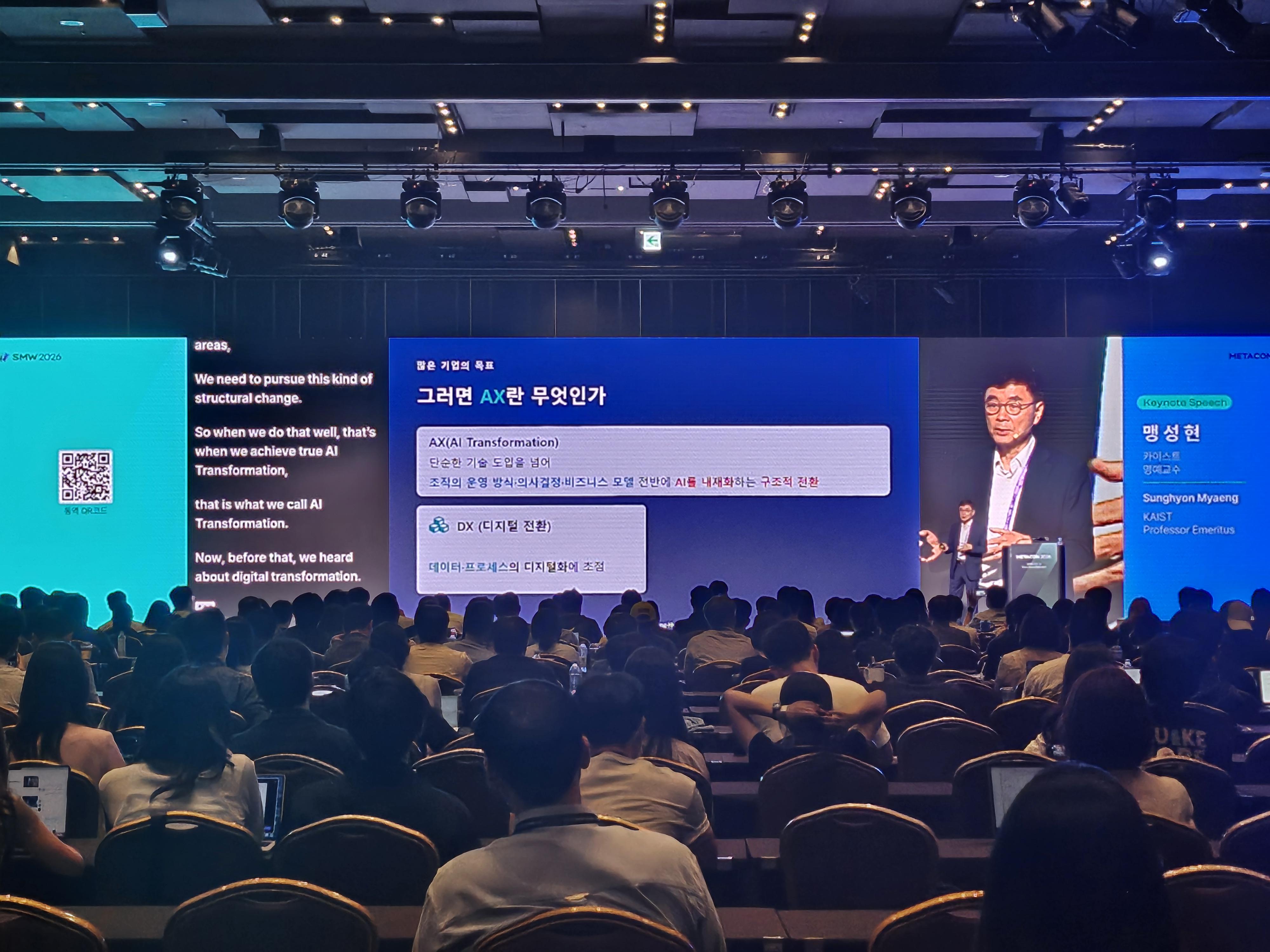
Speaking Thursday UTC at the MetaCon 2026 conference in Seoul, Maeng Seong-hyeon, emeritus professor at KAIST, delivered a keynote titled “Beyond AX to X+AI Convergence: Leadership for the AI-Native Era.” Maeng said competitive advantage in the AI era will hinge less on how many AI systems a company has introduced and more on how thoroughly it has re-architected its business, culture, and governance for a world where AI is embedded everywhere.
Maeng framed the industry’s trajectory using two connected concepts: artificial general intelligence, or ‘AGI’, and the ‘AI-native’ era. He characterized AGI as a stage where AI can perform nearly all tasks humans can do—at or above human level—and argued that the market is already moving past today’s conversational and reasoning models toward ‘agentic AI’ that can plan and act in multi-step workflows. He added that roadmaps increasingly point to AI systems capable of conducting novel research and even supporting organizational management functions.
In parallel, Maeng stressed that the AI-native era will be defined not simply by more powerful models, but by ubiquitous deployment. As AI spreads from cloud services into devices, robots, and ambient computing environments, continuous interaction between humans and AI will become the default. Over time, he argued, users will stop consciously “using AI” in the way they think about applications today—making the strategic question not whether to use AI, but ‘how deeply’ and ‘in what way’ it should be embedded into the enterprise.
That distinction matters for corporate transformation programs increasingly branded as ‘AX’—AI transformation. Maeng said AX must extend beyond technology rollout to structural changes in how organizations operate, make decisions, and monetize products. If digital transformation (‘DX’) focused on digitizing data and processes, he argued, AX introduces AI as a participant in judgment and execution, effectively shifting parts of the organization’s “agency” to machines.